
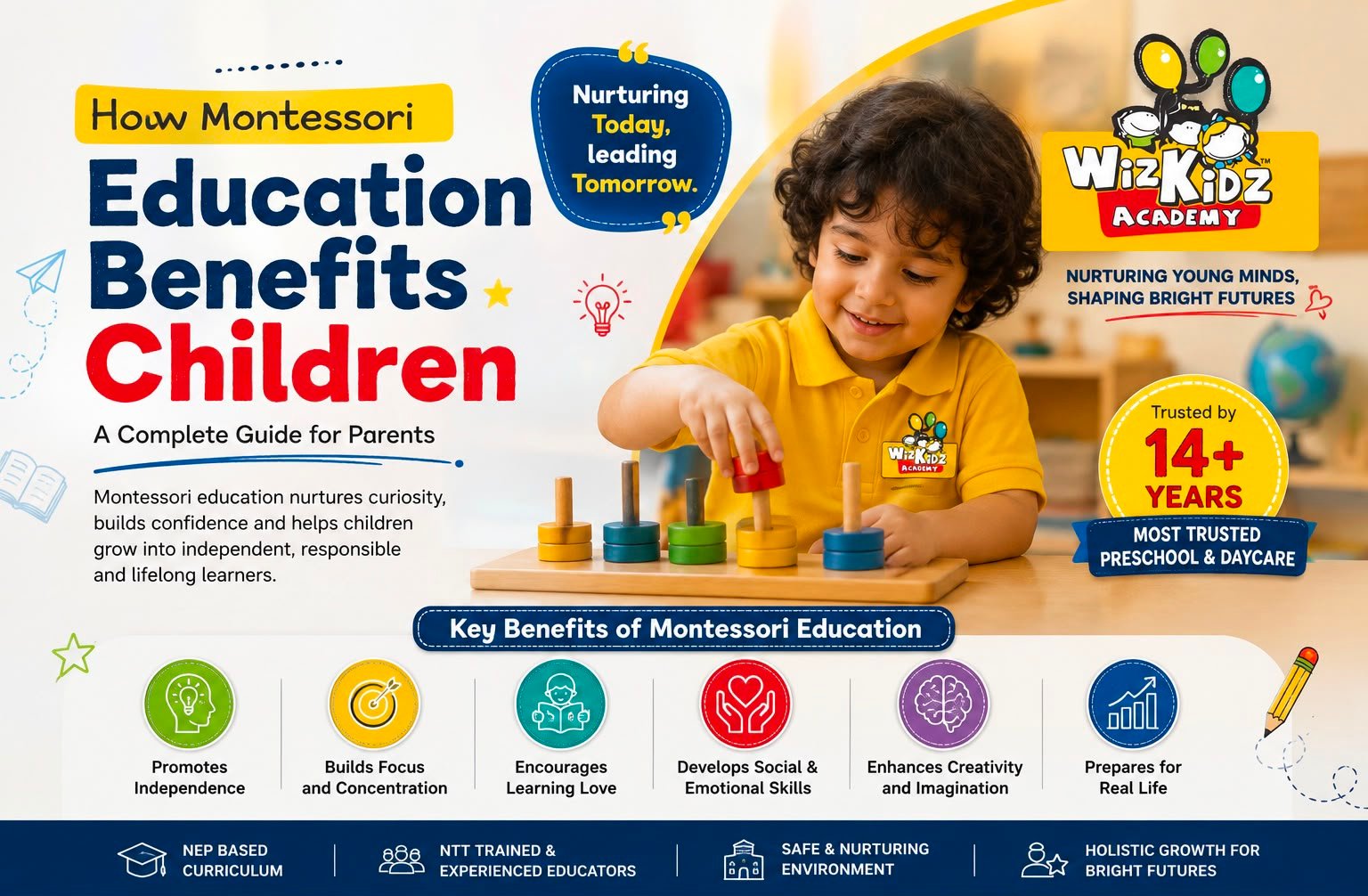
Selecting the proper educational approach for your child is one of the toughest choices you’ll have to make in your role as a parent. In the initial years of their lives, children are equipped with essential cognitive, emotional, social and physical skills which will help them later on. Among several other educational techniques available nowadays, Montessori education has won international recognition due to its child-oriented approach.
As opposed to conventional classrooms in which all the students move at the same pace, children are encouraged in Montessori education to learn on their own, pursue their areas of interest and become more confident through practical experience. This teaching method, founded by Dr. Maria Montessori, operates on the basis of the idea that all the children have the inherent capability of learning if the right surroundings are provided to them.
Here we will try to understand how Montessori education helps children, why parents prefer Montessori schools and how this technique prepares children for future success.
What Is Montessori Education?
Montessori Education is a system of education formulated by Dr. Maria Montessori, an Italian physician and educator, more than a century ago. It emphasizes the importance of enabling children to acquire knowledge through exploration, practice, and independent learning.
In contrast to using the conventional methods of learning such as lecturing and filling in worksheets, Montessori system makes the children:
Learn by doing
Select activities according to their own interest
Work independently as well as cooperatively
Gain practical life skills
Build up self-confidence through practice
Teachers function more as facilitators who assist children in discovering knowledge.
Why Montessori Education Is Different from Traditional Learning
Traditional education often emphasizes memorization, standardized testing, and teacher-led instruction. Montessori classrooms take a completely different approach.
| Traditional Education | Montessori Education |
|---|---|
| Teacher directs lessons | Child chooses activities |
| Same pace for everyone | Individual learning pace |
| Focus on grades | Focus on mastery |
| Fixed curriculum | Flexible learning path |
| Passive learning | Hands-on exploration |
| Competitive environment | Collaborative environment |
This child-centered approach allows children to develop naturally while enjoying the learning process.
Top Benefits of Montessori Education for Children
1. Encourages Independence
One of the key benefits of Montessori schooling is that it helps children learn how to be independent right from childhood.
These include:
Learning to dress on their own
Clearing up after their activities
Arranging their things
Preparing snacks
Decision-making
With these accomplishments without continuous help from the adults, children get more self-confidence and responsibility.
Why It Is Important
The children who are independent tend to become better problem-solvers and learners for their whole lives.
2. Builds Self-Confidence
In Montessori classrooms, the kids have an opportunity to finish activities in their own time and without any risk of failure or comparison.
Instead of being told “You’re wrong,” the kids are encouraged to keep trying by using special learning tools that help them recognize and fix mistakes.
This leads to:
Confidence
Persistence
Positive self-respect
Motivation
The kids understand that making mistakes is natural when learning.
3. Promotes Hands-On Learning
Children learn better when engaged rather than simply being talked at.
Montessori classrooms have special learning materials which stimulate various senses.
Some examples are:
Practical Life Activities
Water pouring
Bead threading
Table washing
Floor sweeping
Sensorial Activities
Color grading
Texture exploring
Sound differentiation
Shape exploration
Academic Materials
Beading counting
Letters sandpaper
Number rods
Puzzle maps
4. Fosters a Passion for Learning
The biggest advantage of Montessori Education is intrinsic motivation.
In contrast to studying in order to get grades or prizes, children study because they love learning and exploring new concepts.
Children automatically become very curious when they pursue activities that interest them.
5. Develops Concentration Skills
In Montessori classrooms, the children have undisturbed time to work deeply on any task.
Less unnecessary interruptions allow the child to:
Become patient
Extend attention span
Work independently
Concentrate deeply
Good concentration skills help children in their academics as well as in their personal lives.
6. Promotes Problem-Solving Skills
Montessori teachers do not give solutions directly but teach students to find solutions by themselves.
Students are taught to:
Think critically
Analyze the situation
Experiment
Take decisions
Learn from mistakes
Such problem-solving skills become useful later on.
7. Encourages Social Development
Montessori classrooms normally consist of students of all ages learning together.
Younger children can be guided by older classmates, while older children learn from watching the younger ones.
Such environment fosters:
Respect
Cooperation
Leadership
Empathy
Communication
Students learn to work together rather than compete against each other.
8. Fosters Responsibility
Children become responsible for their learning environment.
They:
Put back the materials used
Tend to classroom plants
Keep work areas clean
Value shared material
This develops discipline among children in an organic manner.
9. Develops Creativity
Imagination is promoted in Montessori education instead of restricting children to one solution.
This involves:
Creative thought
Telling stories
Drawing
Singing
Exploring
Innovations
The child learns how to think for himself rather than just memorize facts.
10. Fosters Emotional Intelligence
The Montessori approach to education gives equal weight to emotional development.
Children are taught to:
Understand their emotions
Settle differences in a peaceful manner
Show respect for others
Be kind
Be empathic
This social and emotional development greatly aids future success.
Key Montessori Principles That Benefit Children
Child Centered Education
Every child is taught based on their own interests and development.
Prepared Environment
The classroom is organized in such a way as to foster independence and curiosity among children.
Freedom with Structure
Children can choose activities of their interest as per the classroom norms.
Learning Through Experience
Learning is done through interaction with actual objects as opposed to being done only through books.
Respect for the Child
Teachers appreciate the uniqueness and individuality of every child.
Is Montessori Education Suitable for Every Child?
Montessori schooling is good for many children as it provides for various types of learners and holistic growth of a child. This educational model works well with those children who like to explore, learn on their own, and engage in practical exercises.
Nevertheless, every child is an individual. Parents need to think about their children’s personalities, preferences, and requirements and find the appropriate school for their children.
Tips for Parents Choosing a Montessori School
Hire Trained Montessori Teachers
Educators trained in Montessori education methods will have an understanding of the Montessori approach and can effectively teach children.
Watch the Classrooms
A good Montessori classroom is peaceful, well-organized, and stocked with children-sized learning materials.
Note the Independence of Children
See if the children are learning on their own without instructions from teachers.
Learn about Daily Schedule
A comprehensive Montessori program involves practical life skills, language, math, sensorial activities, cultural activities, art, and physical activities outside.
Create a Safe and Comfortable Surrounding
Learning occurs efficiently in an atmosphere of safety, respect, and encouragement.
Conclusion
In Montessori education, however, academic success is just part of the package. Children learn to be confident, independent, curious, and responsible learners, acquiring invaluable social, emotional, and practical life skills at the same time.
Through exploring their surroundings, discovering things hands-on, and finding answers through self-discovery, children in Montessori classrooms love to learn. Besides preparing them for school, the experience also gives them the confidence and skills necessary in life.
If you want an educational approach that encourages your child’s natural development while nurturing independence, creativity, and life-long learning, then Montessori education is definitely one of your best choices.
Frequently Asked Questions (FAQs)
1. What is the major advantage of Montessori education?
Its major advantage lies in the promotion of independent learning with the development of confidence, responsibility, and love of learning for life.
2. When should a child begin Montessori education?
A lot of Montessori schools enroll children between 2.5 and 3 years old, but there are infant-toddler programs as well.
3. Is Montessori education superior to traditional one?
There is no definite answer, and each type of education has its merits. The main difference is that Montessori emphasizes self-directed and hands-on learning, whereas traditional relies on teacher-led lessons. It all depends on the needs of a child.
4. Are Montessori students successful in their academics?
Sure, Montessori kids usually excel in reading, writing, problem solving, and critical thinking since they get a grasp of concepts practically.
5. Is Montessori education helpful in preparing children for primary school?
Certainly, Montessori prepares children both academically and socially to enter primary school easily.
<script type="application/ld+json">
{
  "@context": "https://schema.org",
  "@type": "FAQPage",
  "mainEntity": [{
    "@type": "Question",
    "name": "1. What is the major advantage of Montessori education?",
    "acceptedAnswer": {
      "@type": "Answer",
      "text": "Its major advantage lies in the promotion of independent learning with the development of confidence, responsibility, and love of learning for life."
    }
  },{
    "@type": "Question",
    "name": "2. When should a child begin Montessori education?",
    "acceptedAnswer": {
      "@type": "Answer",
      "text": "A lot of Montessori schools enroll children between 2.5 and 3 years old, but there are infant-toddler programs as well."
    }
  },{
    "@type": "Question",
    "name": "3. Is Montessori education superior to traditional one?",
    "acceptedAnswer": {
      "@type": "Answer",
      "text": "There is no definite answer, and each type of education has its merits. The main difference is that Montessori emphasizes self-directed and hands-on learning, whereas traditional relies on teacher-led lessons. It all depends on the needs of a child."
    }
  },{
    "@type": "Question",
    "name": "4. Are Montessori students successful in their academics?",
    "acceptedAnswer": {
      "@type": "Answer",
      "text": "Sure, Montessori kids usually excel in reading, writing, problem solving, and critical thinking since they get a grasp of concepts practically."
    }
  },{
    "@type": "Question",
    "name": "5. Is Montessori education helpful in preparing children for primary school?",
    "acceptedAnswer": {
      "@type": "Answer",
      "text": "Certainly, Montessori prepares children both academically and socially to enter primary school easily."
    }
  }]
}
</script>