
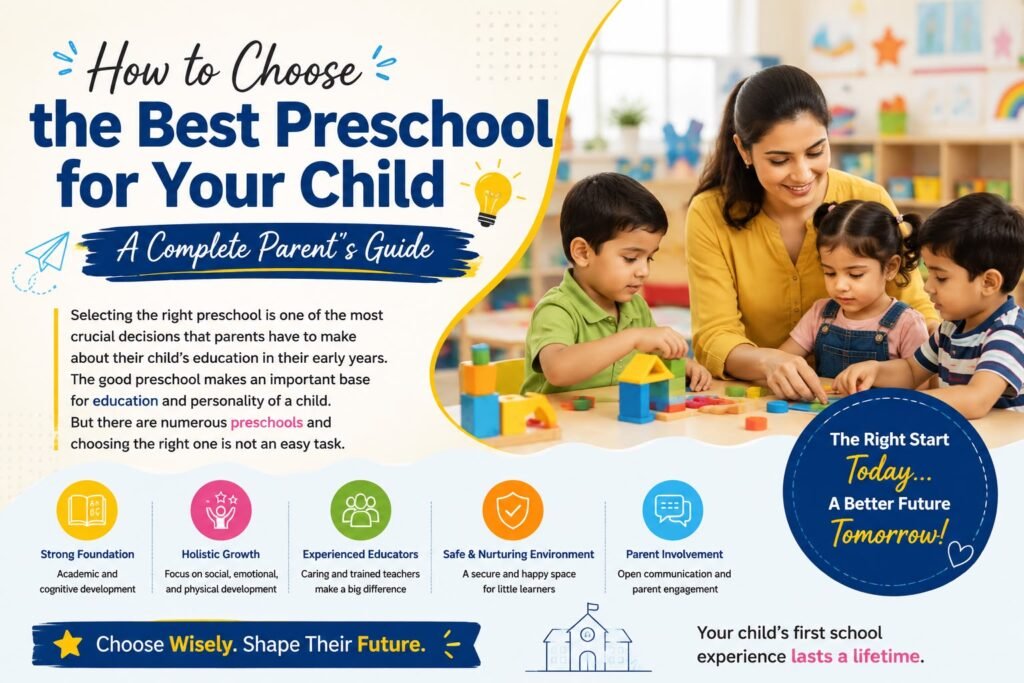
Selection of the right preschool is one of the most crucial decisions that parents have to make about their child’s education in their early years. The good preschool makes an important base for education and personality of a child. But there are numerous preschools and choosing the right one is not an easy task.
This manual will tell you how to choose the right preschool, which questions you should ask and what you should be focused on. By the end of this article you will know how to choose a good preschool for your kid.
Why Choosing the Right Preschool Matters
The first five years of a child’s life is crucial for brain development. In this stage, a child acquires necessary skills like cognitive skills, emotional development, social skills, and communication which affect how he will learn in future.
A good preschool should make children to:
Gain literacy and numeracy skills at an early age
Develop communication and language skills
Learn social interaction and cooperation
Gain independence and confidence
Be creative and solve problems
The best preschool not only educates but develops a child in all aspects.
Understand Your Child’s Needs First
Every child is unique. Before visiting preschools, consider your child’s personality and learning style.
Consider Your Child’s Personality
Ask yourself:
- Is your child shy or outgoing?
- Do they enjoy group activities?
- How easily do they adapt to new environments?
- Do they require extra emotional support?
Understanding your child’s temperament will help you choose a preschool that suits their individual needs.
Think About Learning Preferences
Some children learn through play, while others enjoy structured activities. The ideal preschool should balance both approaches.
Look for a Safe and Secure Environment
Your safety comes first.
A good preschool will have:
Secure entrance and exit points
Surveillance cameras
Child-proof classroom spaces
Sanitized facilities
Evacuation plans
Teachers with first-aid training
Safe play areas
Watch out for how teachers watch over children in class and outside.
Evaluate the Curriculum
A preschool curriculum should facilitate learning through exploration and not memorization.
Consider programs which offer:
Play-based Learning
Children learn through play naturally. The activities should foster creativity and imagination.
Early Literacy
The preschool should teach children about:
Storytelling
Pictures
Letters
Words
Basic Numeracy
The child should be taught:
Numbers
Shapes
Colours
Patterns
Physical Development
Activities should include:
Outdoor Games
Development of fine motor skills
Movement and music
Arts and crafts
A balanced curriculum is vital for holistic child development.
Check Teacher Qualifications and Experience
Teachers have the most significant impact on your kid’s preschool education experience.
Search for teachers who are:
Certified in Early Childhood Education
Expert in dealing with kids
Approachable
Patient and caring
Good communicators
See how teachers interact with kids during your tour.
Question yourself:
Do children feel comfortable with them?
Do teachers motivate kids to participate?
Are they respectful to kids?
Good teacher-kid interaction creates a conducive learning environment.
Maintain a Healthy Teacher-to-Child Ratio
With smaller classes, there will be individual attention for the children.
The best preschool is supposed to have a good teacher-child ratio whereby each and every child gets sufficient attention.
Small classes will foster:
Good communication
Good relationships
Effective classroom management
Personalized learning
Visit the Preschool in Person
Do not rely only on brochures and websites.
Take a tour and pay attention to:
Environment of Classrooms
Are classrooms:
Bright
Colorful
Neat
Child-friendly
Ventilated
Behavior of Children
If children are happy, it is usually a sign of good learning atmosphere.
Are children:
Active
Comfortable
Inquisitive
Respectful
Confident
Interaction with Teachers
Observe how teachers:
Communicate with children
Handle conflicts
Stimulate participation
Praise successes
Such observations will tell you more than advertisements do.
Assess Cleanliness and Hygiene
Younger children are more susceptible to infection.
The following need to be kept clean at the preschool:
Classrooms
Toys
Restrooms
Drinking water
Hand washing
Cleaning schedule
Find out what is their policy regarding illness.
Explore Learning Resources
Stimulation is conducive to exploration.
Good preschools typically provide:
Books
Educational toys
Art materials
Musical instruments
Science corners
Building blocks
Sensorial play materials
The educational tools must be age-appropriate and accessible.
Check Outdoor Play Facilities
Outdoor play is vital for physical and social development.
A preschool needs to offer:
Play equipment that is safe
Open play areas
Gardening
Sandbox play
Water play (if appropriate)
Physical activity options
Outdoor education will aid in developing coordination, self-confidence, and cooperation.
Communication with Parents
Good parent and school communication aids a child’s development.
Select a preschool that offers:
Progress reports
Parent-teacher conferences
Activity reports
Pictures of classroom activities
Open lines of communication
Parents should be included in the learning process of their children.
Understand the Daily Schedule
Request a sample daily timetable.
The best timetable for preschool should have the following:
Circle time
Story time
Free play
Structured learning
Outdoor activities
Snacks
Arts and crafts
Music and movement
Nap time (when needed)
Consider the Preschool’s Values
Each and every preschool will have its unique philosophy.
Some of these philosophies are:
Play-based education
Montessori
Reggio Emilia
Preparation for school
Nature-based education
Select one which suits you as a parent and your child’s needs.
Ask Important Questions Before Enrolling
Prepare a checklist before your visit.
Questions to ask include:
About Teachers
- What qualifications do teachers have?
- How long have they been with the school?
- Do they receive regular training?
About Safety
- What are the emergency procedures?
- Is there CCTV monitoring?
- How are visitors managed?
About Learning
- What teaching methods are used?
- How is child progress assessed?
- How are behavioral issues handled?
About Parent Involvement
- How often are parents updated?
- Can parents communicate directly with teachers?
- Are family events organized?
Consider the Preschool’s Location
Convenience matters.
A preschool close to home or work reduces travel stress and helps maintain a consistent routine.
Long travel times may leave children tired before classes even begin.
Compare Fees and Overall Value
Although affordability is important, affordability alone should not be your only consideration when selecting a preschool.
Think about:
Quality of curriculum
Experience of teachers
Safety regulations
Learning aids
Facilities
Communication between parents and teachers
Early investment in quality education can pay off in the future.
Watch for Red Flags
Stay away from preschools where you can observe any of the following symptoms:
Lack of cleanliness
Crowded classrooms
Inexperienced teachers
Absence of supervision
Lack of teaching materials
Hostile behavior of teachers
Bad communication skills with parents
Dangers associated with playgrounds
Final Checklist Before Making Your Decision
Prior to admission, the following are some characteristics that the preschool must have:
✔ Secure campus
✔ Competent teachers who are caring
✔ Curriculum appropriate for the child’s age group
✔ Learning through playing
✔ Clean facilities
✔ Good teacher-child ratio
✔ Proper communication with the parents
✔ Availability of outdoor play areas
✔ Positive learning environment
If these boxes are ticked, then your preschool is well-selected.
Conclusion
Selecting the perfect preschool for your child is not only academic in nature but involves much more. It involves choosing a preschool that will make your child feel comfortable and safe and happy and eager to learn.
It is worth your while to go out there and see what options are available to you. It’s important to ask the right questions, to watch how children interact in a class, and to follow your parental instinct.
If you select the perfect preschool for your child, you have made an investment in his or her future.
Frequently Asked Questions (FAQs)
1. At what age should my child enter preschool?
Children usually enroll in preschool at 2.5 years to 4 years of age.
2. What should I expect to see when visiting the preschool?
Classroom hygiene, interaction between teachers and children, safety provisions, teaching aids, playground, and happiness of children should be observed during visits.
3. Is a play-based program better than an academic program?
A play-based program is better as it helps develop creativity, communication skills, social skills, problem solving and most importantly, makes learning fun.
4. Why is the teacher-to-student ratio important?
Low teacher-to-student ratio ensures close monitoring of the child.
5. When will I know if my child is ready for preschool?
Some signs include curiosity, communication skills, interest in playing with other kids and willingness to stay away from parents.
<script type="application/ld+json">
{
  "@context": "https://schema.org",
  "@type": "FAQPage",
  "mainEntity": [{
    "@type": "Question",
    "name": "At what age should my child enter preschool?",
    "acceptedAnswer": {
      "@type": "Answer",
      "text": "Children usually enroll in preschool at 2.5 years to 4 years of age."
    }
  },{
    "@type": "Question",
    "name": "What should I expect to see when visiting the preschool?",
    "acceptedAnswer": {
      "@type": "Answer",
      "text": "Classroom hygiene, interaction between teachers and children, safety provisions, teaching aids, playground, and happiness of children should be observed during visits."
    }
  },{
    "@type": "Question",
    "name": "Is a play-based program better than an academic program?",
    "acceptedAnswer": {
      "@type": "Answer",
      "text": "A play-based program is better as it helps develop creativity, communication skills, social skills, problem solving and most importantly, makes learning fun."
    }
  },{
    "@type": "Question",
    "name": "Why is the teacher-to-student ratio important?",
    "acceptedAnswer": {
      "@type": "Answer",
      "text": "Low teacher-to-student ratio ensures close monitoring of the child."
    }
  },{
    "@type": "Question",
    "name": "When will I know if my child is ready for preschool?",
    "acceptedAnswer": {
      "@type": "Answer",
      "text": "Some signs include curiosity, communication skills, interest in playing with other kids and willingness to stay away from parents."
    }
  }]
}
</script>