
Introduction
Preschool years are one of the critical periods in the life of the child. From three to five years of age, the kids learn quickly and acquire skills which will affect the development in the future, such as the ability to study, relationships with people, confidence, and other important things. Although the children can get knowledge at home, in a properly organized preschool, they have all necessary conditions to study, communicate, and solve the problems daily.
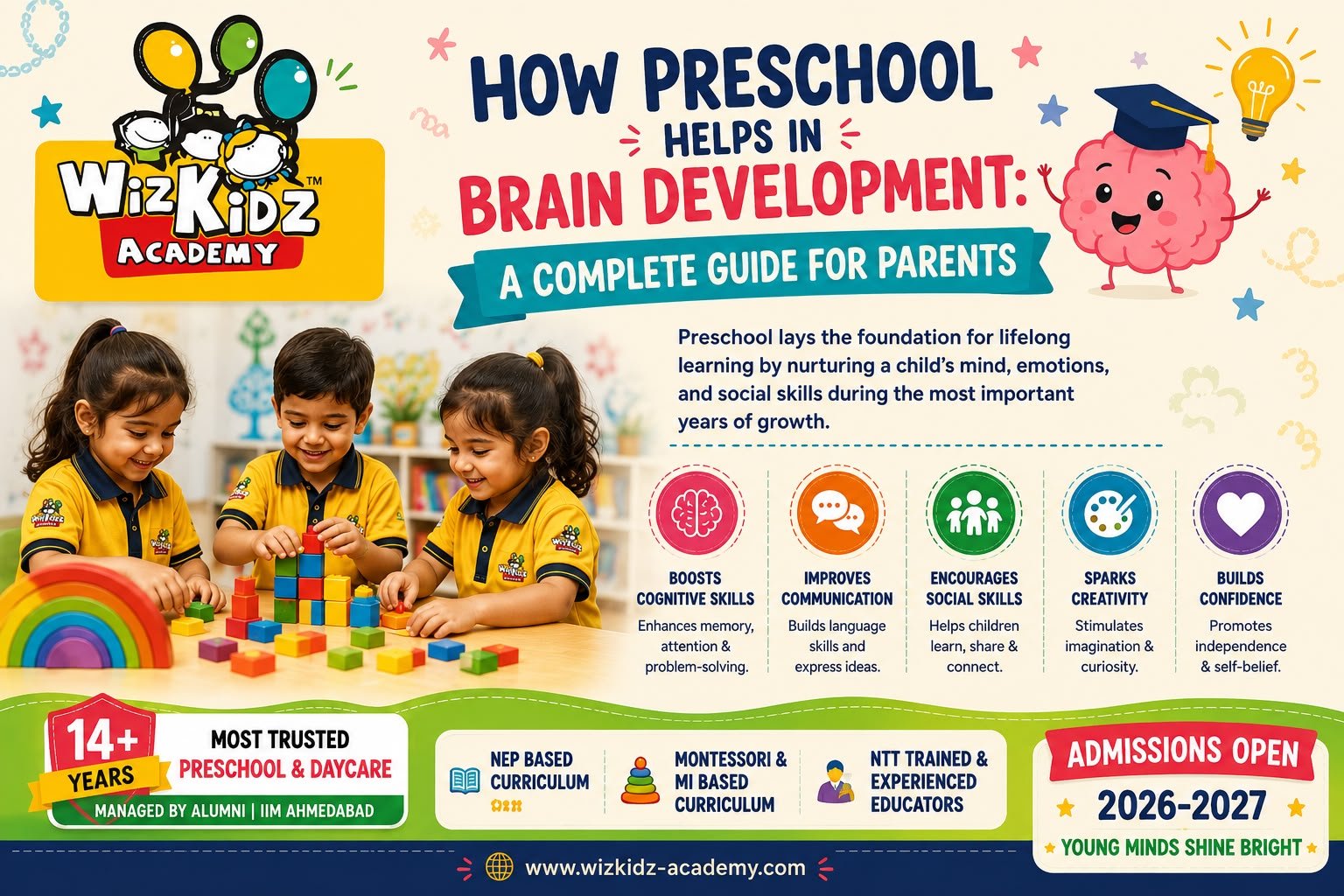
How exactly can a preschool influence the development of the brain? Preschool stimulates the development of the brain because there are age-specific exercises which make the child curious, increase linguistic abilities, develop the memory, attention, creativity, communication, and emotional intelligence.
Preschool is not just preparation for kindergarten. It is the period when a child can learn different things through games, experiments, fairy tales, music, dance, conversation, and communication.
Why Early Childhood Is Important for Brain Development
The early childhood years are characterized by rapid brain development. Children constantly gather information from their environment and learn through their experiences.
Each exchange, each game, story, and any other experience that a child goes through provides the child with the chance to make connections and develop certain skills.
A positive preschool setting can facilitate this process by providing a child with constant opportunities to:
Think about new ideas
Question things
Communicate with both adults and children
Solve problems
Develop motor skills
Follow instructions
Express feelings
Make choices
Act independently
Join group activities
This will provide a good base for further education.
How Preschool Helps in Brain Development
1. Preschool Develops Cognitive Skills
Cognitive development entails how children think, learn, remember, reason, and process information. Preschool activities are usually aimed at developing these skills in children in an enjoyable and age-appropriate manner.
For instance, using jigsaw puzzles can help develop logical thinking skills. Classification activities can teach them how to categorize items based on color, size, or shape. Numbers games can introduce mathematical concepts, whereas matching games can improve memory skills.
Rather than simply memorizing facts, children are given the opportunity to learn concepts through experience.
Preschool Improves Language and Communication Skills
2. Preschool Improves Language and Communication Skills
Language is important in the growth of the brain as children learn to understand and communicate with the world around them using language.
Many opportunities for listening and speaking are available in preschool. Teachers can teach new words to the children through story telling, songs, class discussion, and conversation.
Children can also talk to their peers in the classroom through playing activities. They can learn how to express their thoughts, ask questions, describe events and listen to what other people say.
Language Activities
Common preschool activities include:
Story telling
Reading picture books
Rhyming and singing
Show and tell
Classroom discussion
Dramatization
Word games
Puppetry
Such experiences can boost children’s confidence as communicators in addition to developing listening and comprehension skills.
3. Preschool Encourages Problem-Solving Skills
Problem solving is an essential component of cognitive development. There are minor obstacles that children face during their time in preschool ranging from puzzle completion to learning how to construct a tower using blocks.
Instead of giving the children the answers, good preschool teachers encourage them to consider various solutions.
For instance, if a child’s tower of blocks collapses, the teacher will ask the question, “What else could we do?” This makes the child observe, think, try, and experiment.
These simple instances teach the child that problems can be solved in steps.
4. Preschool Builds Memory and Attention
Younger kids develop their concentration abilities, memory, and task-completion skills slowly and steadily. Through daily classroom activities and routines, young children get plenty of opportunities for developing these skills.
Kids might need to learn classroom rules, understand two- or three-step instructions, remember a portion of a story, or memorize where things belong.
Memory games, sequencing activities, music, and storytelling can turn this process into fun for children.
By doing activities that involve concentrating and remembering information again and again, children start feeling more confident about performing them.
5. Preschool Supports Social Brain Development
Development is not an isolated process for children. Social interaction forms an important component of early learning and development.
Preschool provides children with chances to interact with other children, sharing things, cooperating in playing, and taking part in group activities.
As a result of all these activities, children learn some crucial social skills like:
Sharing
Waiting for one’s turn
Listening
Cooperating
Empathy
Communication
Respecting others
Solving minor conflicts
These interactions also make children realize that people may have different emotions, views, and perspectives.
Learning Through Group Play
Group play is also of great importance since children need to communicate and cooperate in order to take part effectively.
For instance, when playing a make-believe game such as a restaurant, children can divide themselves into a customer, chef or waiter, which would mean that communication and rules have to be obeyed within the game.
6. Preschool Helps With Emotional Development
Brain development is connected not only to thinking and learning but also to emotional development.
Preschool provides children with opportunities to identify and express emotions in a safe environment. Teachers can help children understand feelings such as happiness, frustration, sadness, excitement, and anger.
Children also learn that emotions can be managed in healthy ways.
For example, a child who becomes frustrated while completing an activity can be encouraged to pause, ask for help, and try again.
Over time, children can become better at recognizing their emotions and responding to challenging situations.
7. Preschool Encourages Creativity and Imagination
Creativity allows children to experiment, make choices, and voice their thoughts.
Activities that involve creativity in preschools can range from drawing, painting, music, dance, construction, crafts, storytelling, to role-play.
These activities help children go beyond finding just one right answer.
There is no right way to draw a house or construct anything using blocks. They are allowed to make decisions and give their explanations.
Why Creative Play Matters
Creative play can encourage:
- Imagination
- Flexible thinking
- Self-expression
- Decision-making
- Confidence
- Communication
- Problem-solving
These abilities can support learning across different areas as children grow.
8. Preschool Develops Fine and Gross Motor Skills
Also, the process of physical development helps in the process of learning.
Fine motor movements are small and involve mainly movement of hands and fingers. Such activities as drawing, coloring, cutting using safety scissors, stringing beads, and playing with plasticine help kids develop these movements.
Gross motor movements are large ones and include running, jumping, climbing, dancing, balancing, and outdoor games.
The Link between Movement and Learning
Movement gives kids the possibility of exploring the world around and practicing coordination. A preschool program which combines learning with physical activity is helpful for overall development of children and keeps them busy.
9. Preschool Builds Independence and Executive Function Skills
Executive function is made up of skills that help children control their attention, behaviors, emotions, and actions. Preschool activities provide many chances for children to develop these skills.
Children could be taught to:
Put their things away.
Stick to a daily routine.
Wait for their turn.
Complete tasks.
Follow directions.
Make decisions.
Change from one activity to another.
These activities would eventually lead to self-control, planning, adaptability, and independence.
10. Preschool Makes Learning Interactive
Children at a young age tend to learn better when they can get involved rather than just listening.
In preschool classrooms, it is common practice to use hands-on learning that helps them comprehend.
Teachers might use blocks and counting instead of just talking about numbers. They use shape identification within the classroom environment instead of just talking about shapes. Children can participate in animal songs, stories, and activities instead of reading about them.
Interactive learning can help them better understand and remember new information.
The Role of Teachers in Preschool Brain Development
Educators have an essential part to play in the creation of the learning environment.
A great early childhood educator does not just teach concepts. They notice the interests of the child, pose questions to them, encourage exploration, provide guidance, and give them chances to learn from their mistakes.
Positive teacher-student interaction can also boost confidence in the child while they explore new experiences.
The classroom in which the child is encouraged to ask questions and try something new is likely to foster curiosity in them.
How Parents Can Support Brain Development at Home
Preschool is just a small part of a child’s development. Parents can enhance the learning process at home by doing some simple things.
Parents can:
Read books to their child daily
Discuss their experiences
Ask questions
Play simple games
Let kids explore
Engage in creative activities
Play with the child
Assign tasks based on the child’s age
Keep sleep and meals healthy
Cut down the unproductive screen time
Above all, parents should try to make chances for interactions with the child. Every conversation and game can become a learning experience.
What Should Parents Look for in a Preschool?
Every preschool does not provide the same learning experience. Parents need to think about whether the preschool provides a balanced atmosphere where the child is developing in all aspects.
Look for:
Learning activities suited to the age group
Professional and loving teachers
Safe and friendly classrooms
Opportunities for outdoor play
Story-telling and language activities
Creative and sensory activities
Social interactions
Hands-on learning activities
Positive teacher and child relationship
A balance of structured and unstructured activities
Parents should not be looking for a preschool which will focus on academics alone. The child needs a balanced early learning environment in all aspects.
Conclusion
Preschools can also have an important role in the brain development of young children as the process is greatly facilitated through exploring, communicating, playing, problem solving, building relationships and gaining independence.
The cognitive development of a child can be facilitated through such preschool activities as puzzles and story-telling. Playing in groups and taking part in creative activities are just a few examples that demonstrate how the processes of developing various skills take place on a daily basis at preschools.
Knowing about the processes involved in brain development at preschool age will allow parents to better understand why it is necessary to select the right preschool for their children.
Frequently Asked Questions
1. Is preschool conducive to brain development?
A preschool can assist in brain development when it provides young children with opportunities for age-appropriate language, problem-solving, socialization, creativity, physical activity, and emotional learning.
2. Which skills do children learn through preschool?
Some of the skills that children can learn in preschool include cognitive skills, communication skills, social skills, language skills, motor skills, problem-solving, attention skills, and academics.
3. How can play be effective in aiding brain development?
When children play, they get an opportunity to investigate concepts, make choices, communicate, use imagination, and interact socially, among others. Such skills aid in brain development.
4. Is preschool good for cognitive development?
Yes. Preschool offers opportunities for cognitive development through activities like problem solving, puzzles, matching, counting, storytelling, sorting, building and others.
5. How can parents foster brain development?
Reading, asking questions, playing, engaging in creative activities, talking to your child and giving them opportunities for age-appropriate independence can assist in fostering brain development.
<script type="application/ld+json">
{
  "@context": "https://schema.org",
  "@type": "FAQPage",
  "mainEntity": [{
    "@type": "Question",
    "name": "1. Is preschool conducive to brain development?",
    "acceptedAnswer": {
      "@type": "Answer",
      "text": "A preschool can assist in brain development when it provides young children with opportunities for age-appropriate language, problem-solving, socialization, creativity, physical activity, and emotional learning."
    }
  },{
    "@type": "Question",
    "name": "2. Which skills do children learn through preschool?",
    "acceptedAnswer": {
      "@type": "Answer",
      "text": "Some of the skills that children can learn in preschool include cognitive skills, communication skills, social skills, language skills, motor skills, problem-solving, attention skills, and academics."
    }
  },{
    "@type": "Question",
    "name": "3. How can play be effective in aiding brain development?",
    "acceptedAnswer": {
      "@type": "Answer",
      "text": "When children play, they get an opportunity to investigate concepts, make choices, communicate, use imagination, and interact socially, among others. Such skills aid in brain development."
    }
  },{
    "@type": "Question",
    "name": "4. Is preschool good for cognitive development?",
    "acceptedAnswer": {
      "@type": "Answer",
      "text": "Yes. Preschool offers opportunities for cognitive development through activities like problem solving, puzzles, matching, counting, storytelling, sorting, building and others."
    }
  },{
    "@type": "Question",
    "name": "5. How can parents foster brain development?",
    "acceptedAnswer": {
      "@type": "Answer",
      "text": "Reading, asking questions, playing, engaging in creative activities, talking to your child and giving them opportunities for age-appropriate independence can assist in fostering brain development."
    }
  }]
}
</script>