Introduction
Every parent wishes to give their child the best beginning in life possible. Learning begins at home but preschool provides a more conducive atmosphere for academic, social, emotional, and physical growth of children before they go to school. Many parents ask themselves if preschool is really important or if their kids can just start learning when they reach kindergarten or primary school.
It is a fact that brain growth happens during the first years of a child’s life. According to child development specialists, many portions of brain growth happen before the age of five years, hence making it an ideal period to help children build vital life skills. Preschool programmes allow children the chance to engage in various activities that will prepare them for future learning.
This guide will take you through 10 benefits of taking your child to preschool.
Why Preschool Is Important
Preschooling is not just about spending a few hours every day with the child but is rather an educational environment in which the child learns various aspects like curiosity, creativity, independence, and confidence.
Children who go to preschool develop effective communication skills, control over emotions, and are more prepared for primary school education than children who have not attended preschools.
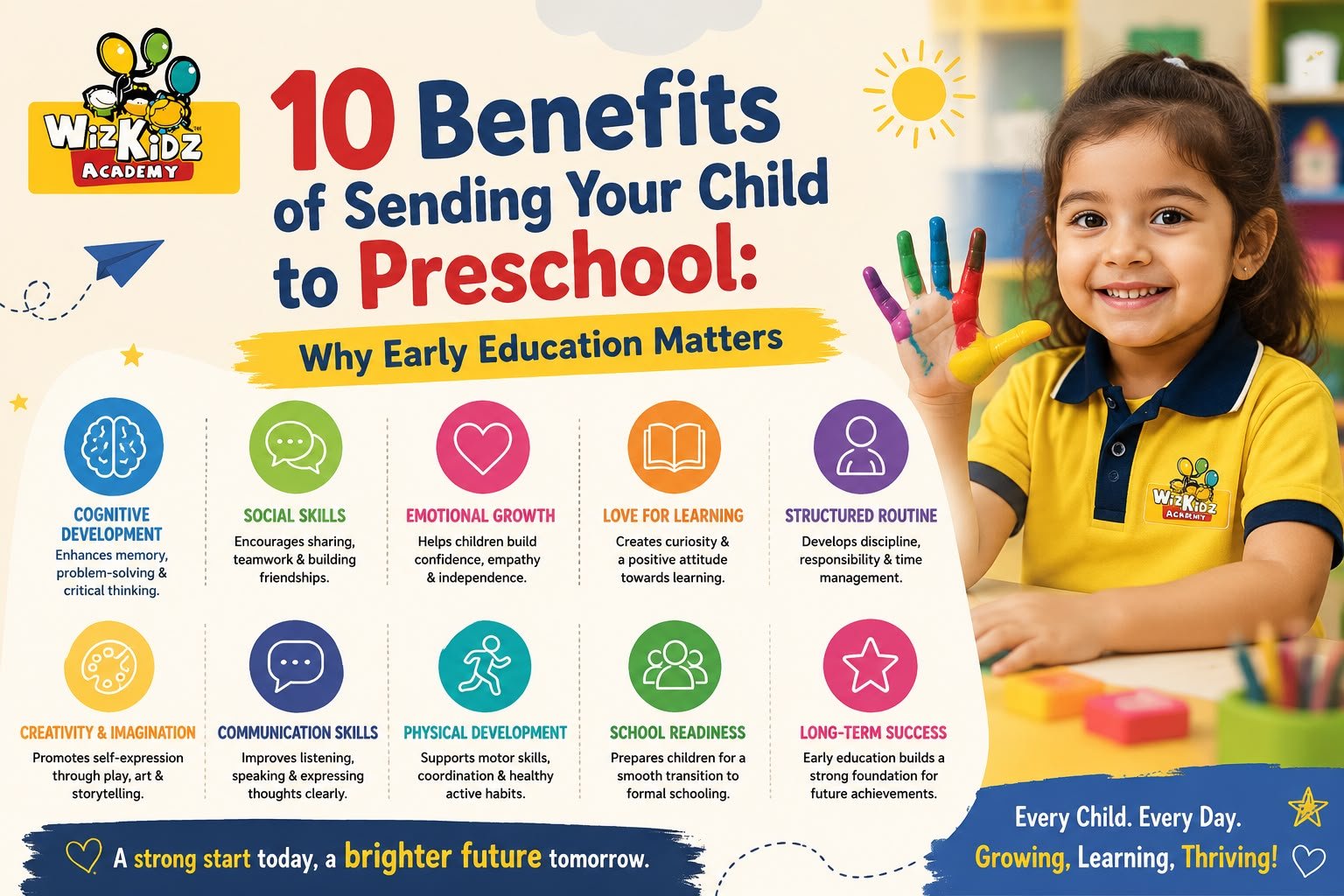
10 Benefits of Sending Your Child to Preschool
1. Builds Strong Social Skills
Preschool’s greatest advantage is that it teaches children how to engage with people around them.
How Preschool Helps with Socialization
Children learn to:
Share toys and instructional resources
Take turns in activities
Work together in groups
Make friends
Solve minor disputes amicably
Develop empathy and kindness
These regular interactions equip the child with essential skills that are useful for life.
2. Encourages Emotional Development
Young children have numerous emotions, but they are not able to express themselves effectively.
Emotions Taught in Preschool
Preschool teachers teach children about:
Recognizing emotions
Dealing with frustration
Becoming confident in themselves
Being patient
Having resilience
Following class routines
Children benefit from learning emotional skills at an early age as they become accustomed to new surroundings.
3. Develops Communication and Language Skills
Preschool provides children with daily exposure to language experience.
Experiences That Enhance Language Development
Children are involved in:
Storytelling
Singing songs
Classroom discussions
Show and tell sessions
Vocabulary building games
Rhyme activities
This makes vocabulary, pronunciation, and listening better.
Effective communication also increases self-confidence in dealing with peers and teachers.
4. Prepares Children for Formal School
Preparing for school entails more than learning letters and numbers.
How Preschool Prepares Kids for Learning
Classroom behavior
Following directions
Sitting quietly
Completing tasks
Listening to teachers
Doing things on one’s own
Kids who know what goes on in a classroom setting tend to enter kindergarten or school without apprehension.
5. Improves Cognitive Development
Preschool exposes children to age-appropriate learning using play.
Cognitive Skills Developed
Activities promote:
Problem solving
Critical thinking
Memory development
Observation skills
Pattern recognition
Reasoning
Games, puzzles, experiments, and hands-on activities trigger curiosity while making learning fun.
6. Encourages Independence
Parents have been concerned about their children’s ability to manage on their own at school.
Preschool helps prepare children to become more independent.
Daily Independence Skills
Children learn how to:
Wash hands
Put away belongings
Eat by themselves
Clean up after playing
Do things in order
Make simple choices
Independent behavior improves confidence and lowers separation anxiety.
7. Enhances Creativity and Imagination
Preschool promotes creativity among children, rather than just having them memorize facts.
Examples of Creative Activities
Painting
Drawing
Molding clay
Music
Dancing
Dramatic play
Telling stories
Playing with building blocks
It enhances self-expression in children as well as their imagination and innovativeness.
8. Promotes Physical Development
Healthy physical development is just as important as academic learning.
Gross Motor Skills
Children improve through:
- Running
- Jumping
- Climbing
- Dancing
- Outdoor games
Fine Motor Skills
Activities include:
- Colouring
- Cutting with safety scissors
- Threading beads
- Writing practice
- Puzzle-solving
Strong motor skills prepare children for writing and everyday tasks.
9. Builds Confidence and Self-Esteem
Every success is another reason for children to believe in themselves.
Be it solving a puzzle, answering a question, singing before class, or writing their name – preschool recognizes every step forward.
Confidence Builds through
Positive reinforcement
Independent learning
Group activities
Classroom duties
Performance events
Daily successes
Confident children are usually eager to explore and solve problems on their own.
10. Creates a Lifelong Love for Learning
The most important thing about preschool is motivating kids to love learning.
Learning becomes fun for children when it comes to them in the form of enjoyment.
Preschool turns learning into fun by
Games
Experiments
Playing outdoors
Reading stories
Listening to music and dancing
Creating art
Classroom interaction
Kids who learn to love learning at an early age always remain passionate about it later on in life.
Additional Advantages of Preschool
In addition to the first ten advantages, preschool also offers:
Routine and Discipline
Routines teach kids about responsibility and time management.
Improved Listening Skills
Kids learn how to listen to directions and be attentive to their tasks.
Stimulated Curiosity
Hands-on exploration promotes kids’ curiosity and helps them find new things out.
Literacy and Numeracy
Kids get acquainted with:
Alphabets
Numbers
Shapes
Colors
Counting
Phonics
These basic skills will help kids learn at school more easily in the future.
Diversity
Preschool teaches kids about diversity among their peers.
How to Choose the Right Preschool
All preschools provide a different form of learning. Various aspects need to be considered prior to making a decision.
Experienced Teachers
The need for teachers who have experience in teaching children.
Safe Learning Environment
A preschool needs to have hygiene, safety, and adequate child supervision.
Play-Based Learning
Young children learn best when they are engaged in playful activities as opposed to being given too much paperwork.
Balanced Learning Program
A good preschool has a balanced program which includes:
Academics
Arts
Physical education
Music
Outdoor activities
Interaction
Parental communication
It is important that you choose a preschool that communicates your child’s progress.
Common Myths About Preschool
Myth 1: Preschools Are for Working Parents Only
Truth: It helps every child develop through learning, irrespective of whether their parents are working or not.
Myth 2: Children Learn Only Through Playing
Truth: Playing is one of the best ways through which young children can learn how to solve problems, communicate, create, and interact socially.
Myth 3: There Is No Need for Preschool When Learning Is Already Happening at Home
Reality: While learning at home is valuable, preschool offers structured group experiences, peer interaction, and professional guidance that are difficult to replicate consistently.
Frequently Asked Questions (FAQs)
1. At what age should a child attend preschool?
The typical age range for entering preschool is from 2.5 to 4 years old.
2. Will attending preschool help my child to become more school-ready?
Preschool will definitely help your child build important skills which will help him/her to be more ready for primary school.
3. Is it required to send my child to preschool before going to kindergarten?
Preschool is not obligatory but it is useful as it provides kids with a good background.
4. For how many hours should a child attend preschool?
There are both part-time and full-time programs available. The best option will depend on the age of your kid and his/her needs.
5. What should my child learn in preschool?
Your child should master various skills like communicating, interacting socially, reading, counting, drawing, etc.
Conclusion
Preschool is among the best investments that you can do for your kid’s future. It does not only help in teaching your kids about ABC’s and 123’s but it also helps them develop their curiosity, confidence, communication, creativity, and independence during the most crucial developmental period of their life.
The 10 reasons why your kids should be enrolled into a preschool are more than what will be taught in the classroom. Aside from being able to foster a love for learning and prepare them for formal schooling, preschool gives them the chance to create lasting friendships while developing essential social skills.
Choosing a good preschool can be really beneficial for your kids’ academic and personal success in the coming years to come.
<script type="application/ld+json">
{
  "@context": "https://schema.org",
  "@type": "FAQPage",
  "mainEntity": [{
    "@type": "Question",
    "name": "1. At what age should a child attend preschool?",
    "acceptedAnswer": {
      "@type": "Answer",
      "text": "The typical age range for entering preschool is from 2.5 to 4 years old."
    }
  },{
    "@type": "Question",
    "name": "2. Will attending preschool help my child to become more school-ready?",
    "acceptedAnswer": {
      "@type": "Answer",
      "text": "Preschool will definitely help your child build important skills which will help him/her to be more ready for primary school."
    }
  },{
    "@type": "Question",
    "name": "3. Is it required to send my child to preschool before going to kindergarten?",
    "acceptedAnswer": {
      "@type": "Answer",
      "text": "Preschool is not obligatory but it is useful as it provides kids with a good background."
    }
  },{
    "@type": "Question",
    "name": "4. For how many hours should a child attend preschool?",
    "acceptedAnswer": {
      "@type": "Answer",
      "text": "There are both part-time and full-time programs available. The best option will depend on the age of your kid and his/her needs."
    }
  },{
    "@type": "Question",
    "name": "5. What should my child learn in preschool?",
    "acceptedAnswer": {
      "@type": "Answer",
      "text": "Your child should master various skills like communicating, interacting socially, reading, counting, drawing, etc."
    }
  }]
}
</script>